
Pull sources
A pull source is a job where HeliosLogs reads logs itself, on a schedule, instead of waiting for a shipper to push them — today, by tailing files on the local filesystem. Useful when HeliosLogs runs alongside an application whose logs are on disk. (S3 and watch/event modes are reserved for the future.)
Manage sources — and the HTTP endpoint on/off switches — under Admin → Data Ingestion → Sources.
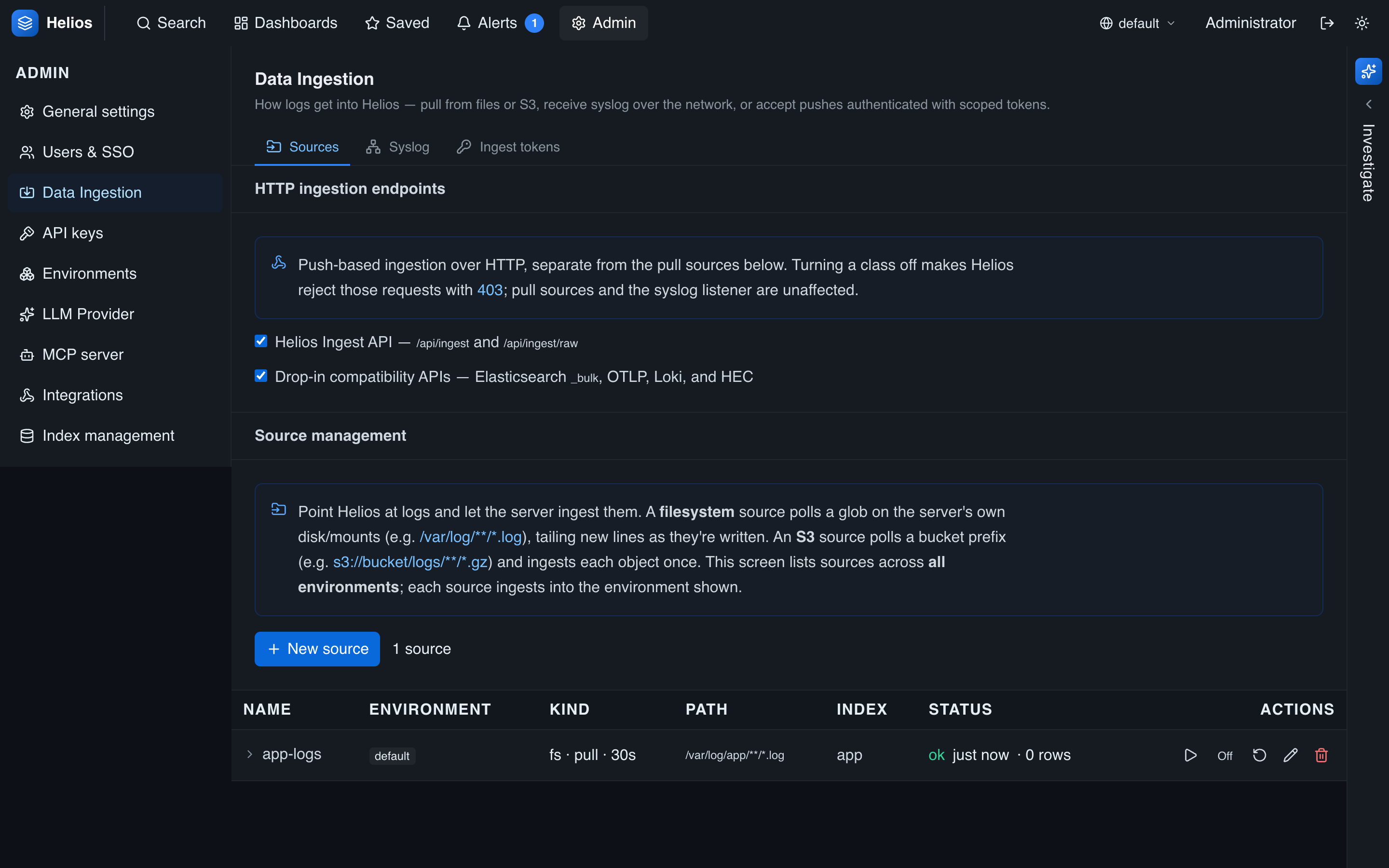
HTTP ingestion endpoints
The top of the Sources tab has the master on/off switches for push-based ingestion (separate from the pull sources below). Turning a class off makes HeliosLogs reject those requests with 403; pull sources and the syslog listener are unaffected.
- HeliosLogs Ingest API —
/api/ingestand/api/ingest/raw. - Drop-in compatibility APIs — Elasticsearch
_bulk, OTLP, Loki, and HEC.
(Require-auth and ingest tokens are on the Tokens tab.)
How pull sources work
A background supervisor polls each enabled source on its interval, reads any new bytes, parses them, and writes the events to the source's env/index. Progress is checkpointed per file, so a restart resumes where it left off rather than re-ingesting.
In a cluster, each run takes a short per-source lease so only one node polls a given source at a time; a lease left stuck (a crash mid-run) is reclaimed after 5 minutes.
Configuring a source
| Field | Notes |
|---|---|
| Name | A label. |
| Environment | The source ingests into your active environment. |
| Index | The storage partition events land in. |
| Path | A glob the source matches, e.g. /var/log/app/**/*.log (** recurses). |
| Exclude | Glob patterns to skip (matched against the absolute path). |
| Format | auto (sniff) or an explicit format — ndjson, json, text, syslog, and the other parser formats. |
| Compression | auto (sniff/extension), none, gzip, or zstd. |
| Multiline | A regex that opens a new event (folds stack traces), with an optional max-lines cap. |
| Grok pattern | A preset, %{...} grok, or named-capture regex (for format=grok). |
| Poll interval | Seconds between polls. Minimum 5, default 10. |
| Source tag | A default source value for events that don't carry one. |
| Enabled | Whether the supervisor runs it. |
Checkpoints (resume vs. re-ingest)
Each source tracks, per file, how many bytes it has consumed and the file's last modification time. This lets HeliosLogs resume cleanly after a restart, and detect rotation (a changed mtime/size re-reads the file from the start). Use the reset action to clear a source's checkpoint and re-ingest from the beginning.
Operating sources
The Sources list shows live status — last run, last status/error, total ingested, and the file currently being read. Actions:
| Action | Endpoint | What it does |
|---|---|---|
| Run now | POST /api/sources/:id/run | Trigger an immediate poll. |
| Reset | POST /api/sources/:id/reset | Clear the checkpoint; re-ingest from the start. |
| Browse | GET /api/sources/browse?path=… | Server-side directory listing (admin) to help build the path glob. |
Full CRUD is available at GET/POST /api/sources and GET/PATCH/DELETE /api/sources/:id.
Local filesystem only
A pull source reads the filesystem of the node running it. Make sure the log paths exist on that host (or are mounted into the container) and that the HeliosLogs process user can read them.