
Notifications & webhooks
Beyond the in-app inbox and toasts, HeliosLogs can POST a webhook whenever an alert is raised — to Slack, a chatops channel, or any HTTP endpoint.
Configure the global target under Admin → Integrations.
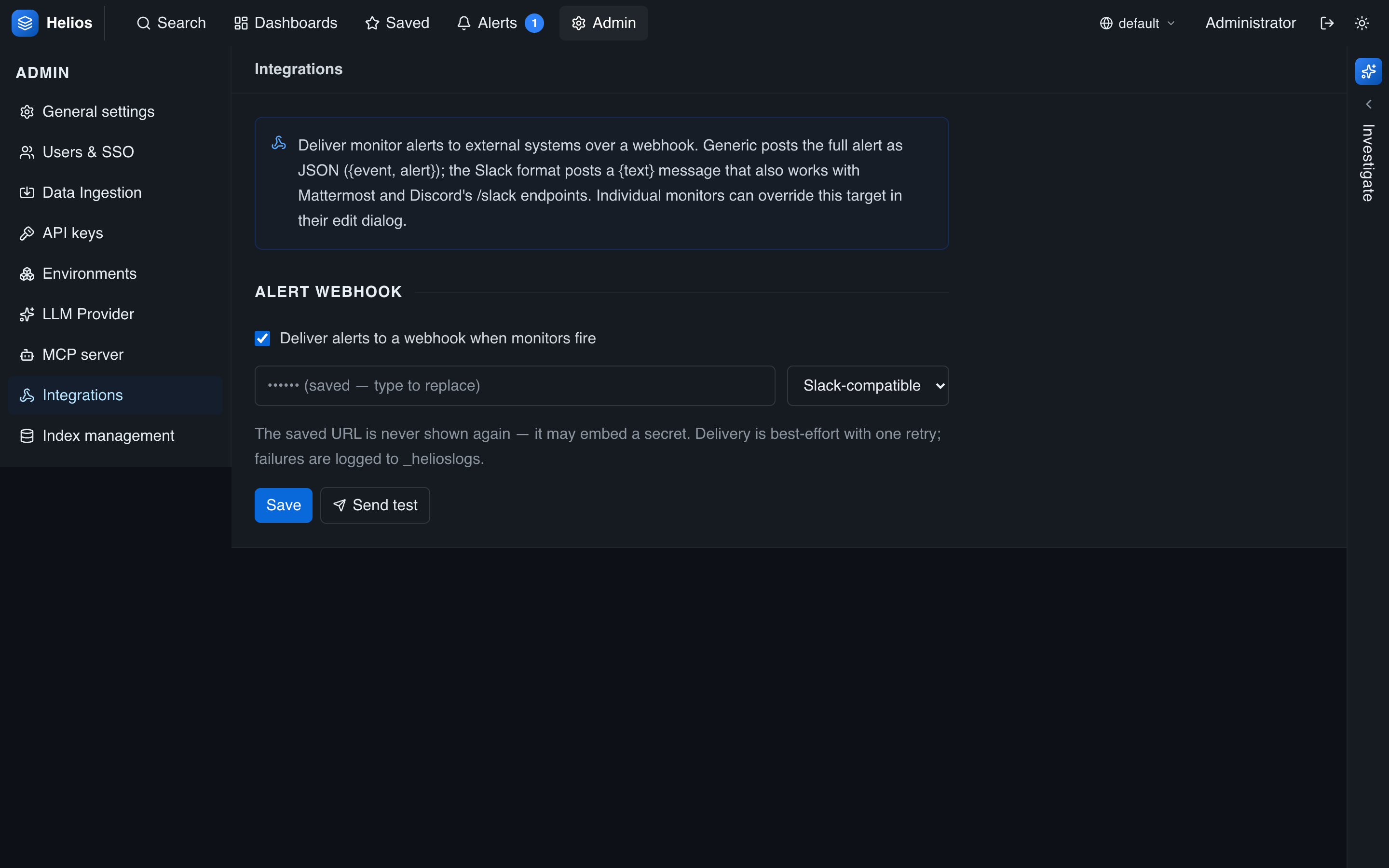
Webhook settings
| Setting | Notes |
|---|---|
| Enabled | Master on/off for webhook delivery. |
| URL | The endpoint alerts are POSTed to. |
| Format | generic (default) or slack. |
Use Send test to fire a synthetic alert at the URL and confirm it's wired up.
Payload formats
Generic — the full alert as JSON, for your own integrations:
{
  "event": "alert.created",
  "alert": {
    "id": "alt_…",
    "monitor_id": "mon_…",
    "monitor_name": "Checkout errors",
    "env": "prod",
    "severity": "high",
    "title": "296 errors in 5m is above the threshold of 50",
    "summary": "…",
    "evidence": { "...": "..." },
    "acknowledged": false,
    "created_at": 1750000000000
  }
}
Slack — a ready-to-post message, compatible with Slack incoming webhooks (and Mattermost / Discord Slack-compatible endpoints):
{ "text": "*[HIGH]* Checkout errors: 296 errors in 5m is above the threshold of 50\n<summary>" }Per-monitor overrides
A monitor can specify its own webhook URL and format, which replaces the global target for that monitor's alerts. Use this to route, say, high-severity production monitors to a paging channel while everything else goes to a general channel.
Delivery semantics
Delivery is best-effort and fire-and-forget: HeliosLogs POSTs the payload with one automatic retry on failure. A failed delivery is logged (and searchable in the _helioslogs self-log) but never blocks or fails the alert itself — the alert is always recorded in the inbox regardless.
SSRF protection
Outbound webhook URLs are validated before each request; private, loopback, and link-local targets are blocked. If you need to deliver to an internal endpoint, front it with an allowed address. See Security hardening.